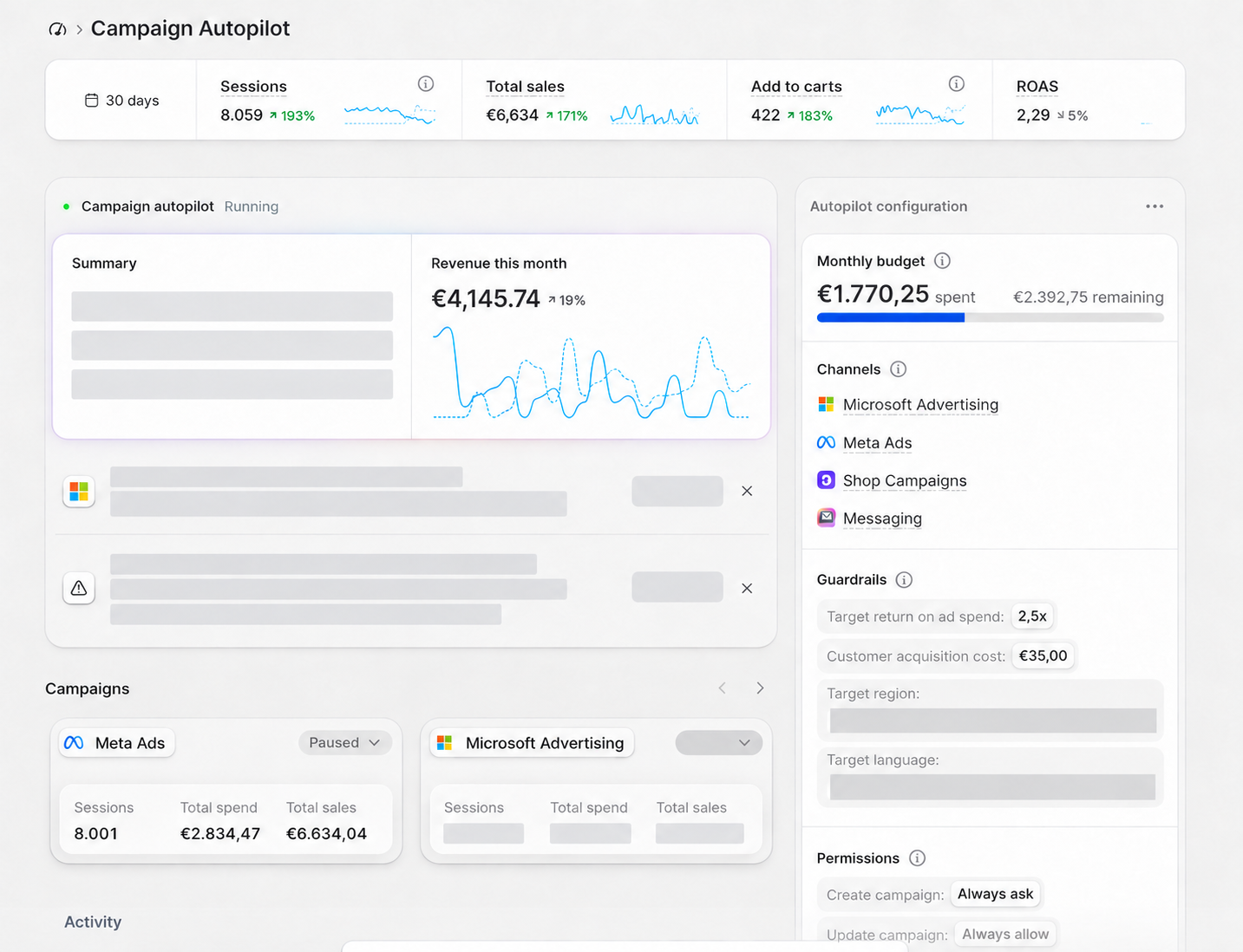
I was given early access to Shopify Campaign Autopilot with the possibility of cashback after allowing it to run for 30 days. I connected several available marketing channels, then deliberately resisted the urge to optimise everything myself. I wanted to see what the system would actually do when given room to work.
The headline numbers were genuinely good
After 30 days, Shopify attributed 8,059 sessions, €6,634 in sales and 422 add-to-carts to Autopilot, with a reported ROAS of 2.29. Those are not numbers I would dismiss. The system generated revenue and drove a substantial amount of traffic.
But the spend was also higher than my usual Meta advertising level. Autopilot showed €2,834.47 spent on Meta against €6,634.04 in attributed sales. Strong enough to take seriously, certainly—but not a case of automation magically producing cheaper growth.
Meta carried the paid performance
The most useful finding was not simply the total, but where it came from. Meta delivered 8,001 of the 8,059 sessions shown in the channel cards and the attributed sales visible in the dashboard. The remaining connected paid channels did not make a material contribution during this 30-day period, so I would treat their results as inconclusive rather than as a final verdict on their potential.
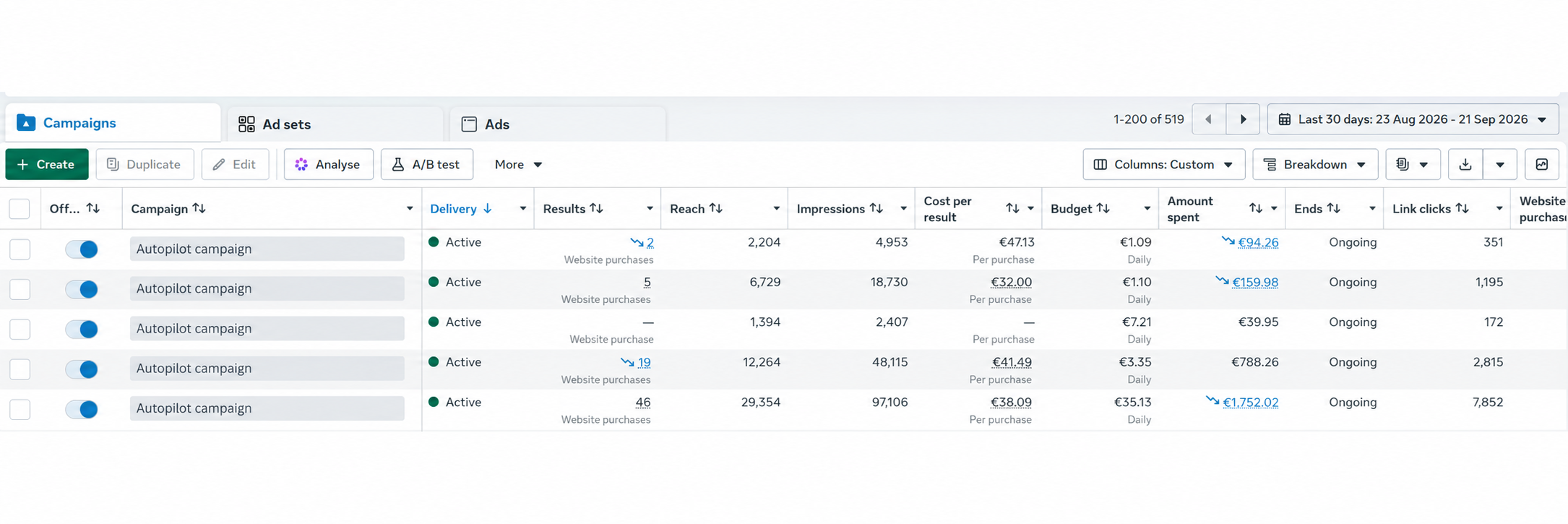
Across those five Meta campaigns, the screenshot shows 72 website purchases from €2,834.47 in spend—a blended cost of roughly €39.37 per purchase. My Autopilot customer-acquisition guardrail was €35, so the result was above my preferred level even though the revenue outcome was good.
The messaging channel overlapped with automations I already had in place, which made its incremental contribution difficult to isolate. For this review, Meta is therefore the only channel from which I can draw a meaningful performance conclusion.
The first setup was broader than I wanted
Autopilot initially launched across all the countries included in my Shopify Markets. That is logical from a platform point of view, but it was not the most efficient use of a limited testing budget. I asked Shopify’s assistant to narrow the targeting to my strongest-converting countries.
This became a recurring theme: you can make changes, but not always directly where you expect. The Shopify dashboard gives you very little hands-on control. To adjust something, you often need to ask the assistant—or leave Shopify and make the change inside the connected advertising platform.
Automation is most useful when it removes repetitive work without removing the judgment that protects the budget.
It launches the campaign. It does not fully work the creative.
On Meta, Autopilot created a fairly standard sales campaign. What it did not do was embrace the platform’s creative recommendations: adapting formats, adding backgrounds, introducing music or making other variations that Meta itself suggests could improve delivery.
I intentionally left those recommendations untouched. Normally I would intervene, but that would have blurred the test. After 30 days, my impression is that Autopilot can get a campaign live and keep it running, but it is not yet acting like an experienced media buyer who continually improves both the structure and the creative.
Who is it good for?
For someone with little Meta advertising experience—or a founder who simply cannot be bothered to spend time inside Ads Manager—this is a genuinely useful idea. It lowers the barrier to launching campaigns, connects the channels in one place and presents the results in a much less intimidating way.
For an experienced advertiser, the limitations are more obvious. I want clearer channel-level learning, more control without having to prompt a robot, stronger creative adaptation and more evidence that the system is optimising beyond the basic campaign setup.
My verdict after 30 days
Shopify Campaign Autopilot is promising, and I cannot argue with the fact that it generated good sales during this test. But “Autopilot” currently overstates how independently the system improves performance. The 30-day result was concentrated heavily in Meta, and the spend was higher than I would normally be comfortable leaving largely untouched.
I hope I am selected to speak with a Shopify expert about the trial. I would love to understand what was happening behind the interface, what the system learned, and how Shopify plans to turn a convenient campaign launcher into a genuinely adaptive advertising tool.
Bottom line
Great concept. Useful for beginners and time-poor founders. Real results through Meta. But it needs more control, stronger cross-channel delivery and deeper optimisation before I would hand it the keys without supervision.
This is an independent field note based on my early-access test inside my own ecommerce business. Results and platform features may differ by account, market and rollout stage.